
THE MARIANA TRENCH — FOR JR HIGH SCHOOL STUDENTS
DR. MATILDA A. EVANS' CLASS
The Mariana Trench: Earth's Deepest Place
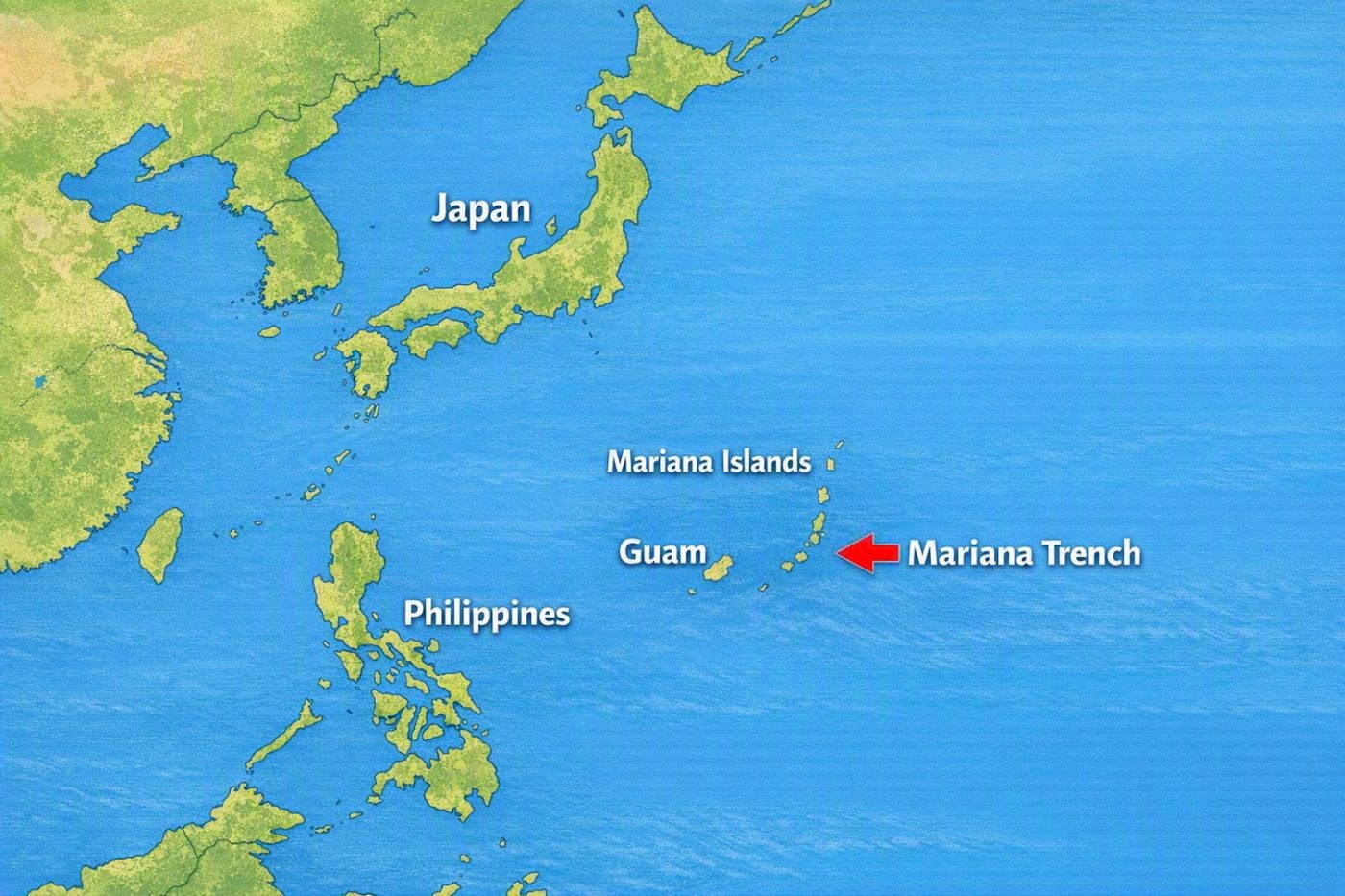
The Mariana Trench is one of the most fascinating places on Earth. Located in the western Pacific Ocean near the Mariana Islands, it is the deepest known ocean trench in the world. Its deepest point, called Challenger Deep, reaches about 35,876 feet, or nearly 6.8 miles, below sea level. That is so deep that if Mount Everest were placed inside it, the mountain's top would still be far underwater. The Mariana Trench helps scientists understand how Earth's surface changes and what life can survive in extreme environments.
The trench was formed by plate tectonics, the movement of large pieces of Earth's crust. In this area, the Pacific Plate is slowly being pushed beneath the smaller Mariana Plate. This process is called subduction. As one plate sinks under the other, the ocean floor bends downward and creates a long, narrow valley. Over millions of years, this movement formed the Mariana Trench. It is a powerful example of how forces deep inside Earth can shape the planet's surface, even under the ocean.
Conditions inside the Mariana Trench are extremely harsh. Sunlight cannot reach the deepest parts, so the water is completely dark. The temperature near the bottom is close to freezing, and the pressure is more than one thousand times greater than the pressure at sea level. This means that most ordinary machines would be crushed if they tried to go there. Because of these conditions, exploring the trench is difficult and requires specially designed submarines, robots, and scientific equipment.
Even though the trench is dark, cold, and under great pressure, life still exists there. Scientists have discovered tiny microorganisms and unusual deep-sea animals that can survive where humans cannot. Some creatures have adapted to the darkness by using senses other than sight, while others depend on food that falls from higher parts of the ocean. Studying these organisms helps scientists learn how life can adapt to extreme places on Earth and possibly even on other planets or moons.
Exploration of the Mariana Trench has a long history. In 1875, the crew of the HMS Challenger measured deep waters in the region, which led to the name Challenger Deep. In 1960, Jacques Piccard and Don Walsh became the first people to travel to Challenger Deep in a deep-diving vessel called the Trieste. Since then, new technology has allowed scientists to make better maps of the trench and learn more about its geology, pressure, and living things.
The Mariana Trench is important because it reminds us that Earth still has many mysteries. Although people have explored mountains, deserts, and space, much of the deep ocean remains unknown. Learning about the trench can inspire students to ask questions about science, technology, and the natural world. It also shows that discovery often requires curiosity, teamwork, and courage.
In conclusion, the Mariana Trench is more than just the deepest place in the ocean. It is a natural wonder created by moving tectonic plates, filled with extreme conditions, and home to life that has adapted in amazing ways. Studying the Mariana Trench is a chance to understand how powerful Earth's processes are and how much there is still to discover beneath the waves.
Study Guide: The Mariana Trench
Key Vocabulary
- Mariana Trench: The deepest known ocean trench on Earth.
- Challenger Deep: The deepest part of the Mariana Trench.
- Plate tectonics: The movement of large pieces of Earth's crust.
- Subduction: The process where one tectonic plate moves underneath another plate.
- Pressure: The force pushing on an object; pressure is extremely strong at the bottom of the trench.
Review Questions
- Where is the Mariana Trench located?
- What is the deepest part of the Mariana Trench called?
- About how deep is Challenger Deep?
- How did the Mariana Trench form?
- What does subduction mean?
- Why is it difficult for humans to explore the trench?
- What kinds of living things have scientists found there?
- Why is the Mariana Trench important to scientists?
- What happened in 1960 that was important in the exploration of the trench?
- What lesson can students learn from studying the Mariana Trench?
Answer Key
- The Mariana Trench is located in the western Pacific Ocean near the Mariana Islands.
- The deepest part is called Challenger Deep.
- Challenger Deep is about 35,876 feet deep, or nearly 6.8 miles below sea level.
- It formed through plate tectonics, when the Pacific Plate was pushed beneath the Mariana Plate.
- Subduction means one tectonic plate moves underneath another plate.
- It is difficult to explore because the trench is dark, very cold, and has extremely strong pressure.
- Scientists have found microorganisms and unusual deep-sea animals that can survive in extreme conditions.
- It helps scientists learn about Earth's geology, deep-sea life, and how organisms adapt to harsh environments.
- In 1960, Jacques Piccard and Don Walsh traveled to Challenger Deep in the Trieste.
- Students can learn that Earth still has many mysteries and that science helps people explore and understand them.