
ATOM AND QUANTUM WAVE — FOR HIGH SCHOOL STUDENTS
DR. MATILDA A. EVANS' CLASS
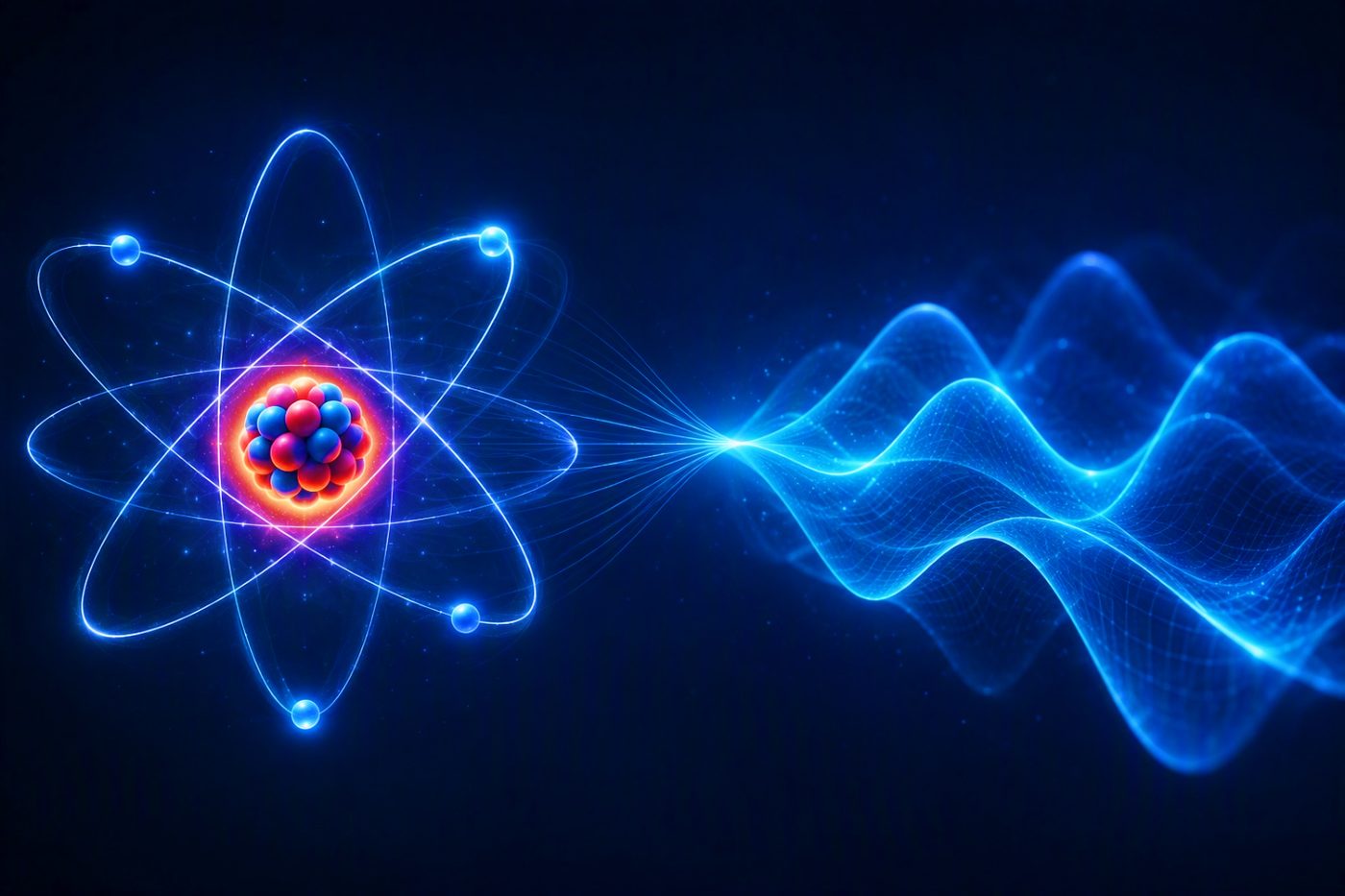
Atom vs. Quantum Wave
Atoms and quantum waves are both important ideas in science, but they describe different things. An atom is a tiny unit of matter, while a quantum wave is a way scientists describe how very small particles, such as electrons, behave. Understanding the difference between them helps explain what matter is made of and why tiny particles do not always act like the objects we see every day.
What Is an Atom?
An atom is one of the basic building blocks of matter. Almost everything around us, including air, water, rocks, plants, and people, is made of atoms. Each atom has a center called a nucleus. The nucleus contains protons and neutrons. Electrons are found around the nucleus, but scientists cannot always say the exact spot where an electron is. Instead, they describe where the electron is most likely to be.
What Is a Quantum Wave?
A quantum wave is not a solid object like an atom. It is a scientific model used to explain how tiny particles behave. In quantum mechanics, particles such as electrons can act partly like particles and partly like waves. A quantum wave helps show the places where a particle is most likely to be found. It does not mean the particle is exactly like a water wave. It means the particle follows wave-like rules that scientists can use to make predictions.
How They Are Different
The main difference is that an atom is a thing made of matter, while a quantum wave is a way to describe behavior. An atom has parts, including protons, neutrons, and electrons. A quantum wave does not have parts in the same way. It works more like a map of possibilities. For example, an electron in an atom is not always in one exact place. The quantum wave helps scientists predict where that electron is probably located.
Atoms help explain what different materials are made of. For example, hydrogen, oxygen, and carbon are different because their atoms have different numbers of protons. Quantum waves help explain how the tiny parts inside atoms behave. They also help explain why electrons have certain energy levels and why atoms can join together to make molecules.
Conclusion
In conclusion, an atom is a tiny unit of matter, and a quantum wave is a way to describe what a tiny particle might do. Atoms make up the world around us, while quantum waves help scientists understand the small particles inside atoms. In simple terms, an atom is matter, and a quantum wave is a way to explain how tiny particles act.
Watchable educational video: Quantum Wavefunction (Khan Academy — search “quantum wavefunction”).
Study Guide: Atom vs. Quantum Wave
Big Idea
An atom is a tiny unit of matter. A quantum wave is a model scientists use to describe how tiny particles, especially electrons, behave. Atoms make up matter, while quantum waves help explain what happens inside atoms.
Key Vocabulary
- Atom: The basic building block of matter.
- Matter: Anything that has mass and takes up space.
- Nucleus: The center of an atom, made of protons and neutrons.
- Electron: A tiny negatively charged particle found around the nucleus.
- Quantum wave: A way to describe where a tiny particle is likely to be found.
- Probability: The chance that something will happen.
Main Differences
| Atom | Quantum Wave | | --- | --- | | A tiny unit of matter | A model that describes tiny particle behavior | | Has parts like protons, neutrons, and electrons | Shows where a particle is likely to be found | | Helps explain what objects are made of | Helps explain how electrons act inside atoms |
Review Questions
- What is an atom?
- What particles are found in the nucleus?
- Why do scientists use quantum waves?
- How is an atom different from a quantum wave?
- Why can scientists not always say the exact place of an electron?
Quick Quiz
- An atom is a tiny unit of __________.
- The center of an atom is called the __________.
- A quantum wave helps show where a particle is most likely to be __________.
- True or False: A quantum wave is a solid object.
- True or False: Electrons are part of atoms.
Answer Key
Review Questions:
- An atom is a tiny unit of matter and one of the basic building blocks of everything around us.
- Protons and neutrons are found in the nucleus.
- Scientists use quantum waves to describe where tiny particles, like electrons, are most likely to be found and how they behave.
- An atom is a physical unit of matter, while a quantum wave is a model that describes a tiny particle's behavior.
- Scientists cannot always say the exact place of an electron because electrons follow quantum rules, so scientists describe where they are most likely to be.
Quick Quiz:
- matter
- nucleus
- found
- False
- True